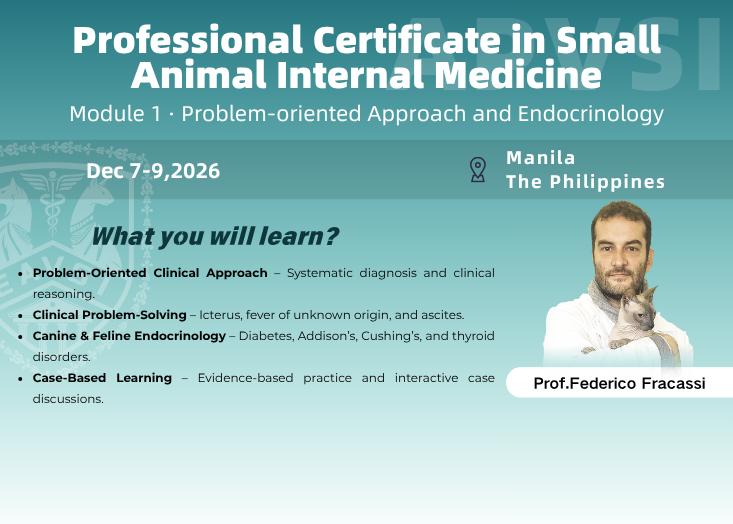
Courses Overview
Prof. Federico Fracassi
DVM, PhD, Dipl ECVIM-CA
Dec 7-9, 2026 | Manila, The Philippines
Course Overview
The Professional Certificate in Small Animal Internal Medicine is a comprehensive veterinary education program designed to strengthen clinical reasoning, diagnostic skills, and case management in dogs and cats. Through a systematic, problem-oriented approach, veterinarians will learn to evaluate clinical signs, interpret diagnostic findings, and develop effective, evidence-based treatment strategies.
The program covers five core areas of small animal internal medicine:
Module 1: Problem-Oriented Approach and Endocrinology – Structured clinical reasoning, diagnostic workflows, and endocrine disorders.
Module 2: Clinical Pathology, Hematology and Infectious Diseases – Laboratory interpretation, hematological disorders, and infectious disease diagnosis.
Module 3: Gastroenterology and Hepatology – Diagnosis and management of gastrointestinal and liver diseases.
Module 4: Respiratory Medicine – Diagnostic approaches and clinical management of respiratory disorders.
Module 5: Nephrology and Urology – Assessment and management of kidney diseases and urinary tract disorders.
Led by experienced international veterinary specialists, this professional certificate program provides a structured learning pathway for veterinarians seeking to advance their knowledge of canine and feline internal medicine. By integrating systematic diagnostic thinking with evidence-based clinical practice, the program aims to help participants improve clinical decision-making and manage complex internal medicine cases with greater confidence.
The Professional Certificate in Small Animal Internal Medicine – Module 1: A Systematic Problem-Oriented Approach is designed to help veterinarians strengthen their clinical reasoning and diagnostic skills in canine and feline internal medicine. Led by Prof. Federico Fracassi, this course focuses on a structured, problem-oriented approach to clinical assessment, diagnosis, and treatment.
Key topics include the evaluation of icterus, fever of unknown origin, abdominal enlargement and ascites, as well as the diagnosis and management of common endocrine disorders, including diabetes mellitus, hypoglycemia, Addison’s disease, Cushing’s syndrome, canine hypothyroidism, and feline hyperthyroidism.
Through clinical case discussions, interactive learning, and small-group problem-solving sessions, participants will develop a more systematic approach to complex clinical presentations and improve their ability to make evidence-based decisions in everyday veterinary practice.
This small animal internal medicine course is ideal for veterinarians seeking to enhance their expertise in clinical problem-solving, canine and feline endocrinology, and evidence-based diagnosis and treatment.
Curriculum
Day 1
l Problem-oriented approach: the steps that follow history taking and physical examination
l How to use and maximize scientific sources
l Approach to the patient with icterus
l Hyperthermia and fever of unknown origin: from the clinical case to the diagnosis
l Increase in volume of the abdomen / ascites: clinical cases
l Problem solving: discussion of clinical cases in small groups
Day 2
l Clinical diagnosis and therapeutic management of diabetes mellitus in canine and feline patients
l Monitoring Diabetes Mellitus
l Interactive discussion of diabetic cases
l Approach to the patient with hypoglycemia
l Diagnosis, Treatment, and Clinical Management of Addison's Disease (Hypoadrenocorticism)
l Interactive discussion of cases
Day 3
l Diagnosis and treatment of Cushing's Syndrome (Hypercortisolism)
l Problem solving: discussion of clinical cases in small groups
l Canine hypothyroidism diagnosis and treatment
l Feline hyperthyroidism: diagnosis and treatment
l Interactive discussion of cases
Instructor
Prof. Federico Fracassi
DVM, PhD, Dipl ECVIM-CA
Dr. Fracassi graduated cum laude with a Doctor of Veterinary Medicine (DVM) degree from the University of Bologna, Italy. In 2005, he defended his PhD thesis and subsequently completed a residency in Internal Medicine at the University of Zurich, Switzerland. He became a Diplomate of the European College of Veterinary Internal Medicine – Companion Animals (ECVIM-CA) in 2012. He is currently Associate Professor of Veterinary Internal Medicine at the University of Bologna.
Dr. Fracassi's primary research focus is small animal endocrinology. He is the Director of the international second-level Master's program in Canine and Feline Endocrinology and has organized the ESVE Summer School in Bologna every two years since 2016. His publication record includes more than 120 articles in peer-reviewed journals and 14 book chapters.
He serves as Editor of Veterinaria, a peer-reviewed journal, and as Associate Editor of the Journal of Small Animal Practice. In 2017, he co-edited Feline Endocrinology (translated into six languages) with Dr. Feldman and Dr. Peterson. In 2022, he edited Diagnostic and Therapeutic Algorithms in Internal Medicine for Dogs and Cats (translated into seven languages), and in 2024 he co-edited Canine Endocrinology with Dr. Sara Galac.
Dr. Fracassi has been invited as a speaker in 24 countries.
Payment Method
· Bank Transfer (CNY / EURO / USD / HKD )
· Alipay
Course Fee
| Problem-oriented Approach and Endocrinology | 30,000 PHP |
Cancellation & Refund Policy
· More than 10 days before the course: 90% of the tuition will be refunded. Within 10 days before the course: Only 50% of the tuition will be refunded. Alternatively, your spot can be transferred to another participant.
· In case of course-related changes (e.g. rescheduling or venue change), a full refund can be requested. No additional compensation will be provided.
· Refunds are typically processed within one month. Thank you for your patience.
· If an invoice is required, please submit your request within 3 months after the course ends. Invoices must be issued within the same calendar year as the tuition payment. No refunds will be processed once an invoice has been issued.